- Salaaz's Newsletter
- Posts
- Hooked on Exploitation: The Dark Side of Global Fishing
Hooked on Exploitation: The Dark Side of Global Fishing
Salaaz Newsletter: Week 50

Salaaz Market
October 14, 2025
The ocean is a scary place, not just because of the unknowns of the sea but also because of the unknowns of how humans use it. It is an effortless place to target with difficult enforceable regulation. This is combined with the fact that the majority of fish are located in the Pacific Ocean makes it a hotspot for countries with low labor rights.
It gets overlooked that one of the world's most vulnerable industries, humanly possible, is the fishing industry. Imagine getting trapped on sea with no means of escape and being forced to work rentless hours for very little compensation. This is the reality with the fishing industry being a hub for human trafficking and labour exploitation.
Here are disturbing facts showing the darkside of supermarket fish:
It is estimated that…Roughly 128,000 workers are trapped in remote fishing vessels around the world. On these vessels they are forced to work for little compensation, physically and verbally assaulted.
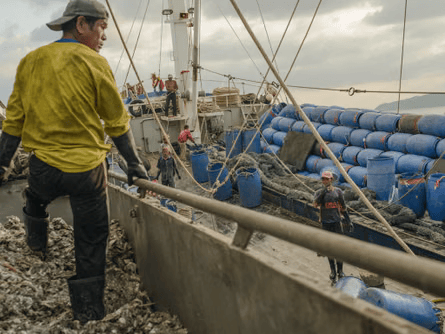
Situations for fishers around the world are unimaginable and inhumane.
Trapped at sea the migrant workers for fish is comparable to that of slavery with high risks of chronic sickness, malnutrition and mortality.
And in the meantime, the fish population is getting destroyed with unregulated levels of fishing. Overfishing is when more fish get taken out of the ocean than can be replenished.
Harmful subsidies estimated to be worth over 22 billion annually are funded by wealthy countries that fuel unsustainable fishing.
One in every five fish is said to be unreported or illegal. This leaves room for vulnerability and abuse without regulation.
Overfishing happens at over one third of the world’s fisheries and greatly endangers fish species such as sharks and rays.
Fishing nets account for more than half of the Great Pacific Ocean Garbage Patch, a big collection of garbage that is bigger than the size of Texas.
Fish fraud is a worldwide issue with mislabeling and having the wrong kind of fish and not the one you paid for. In a study with 9000 products, Canada had the largest rate of mislabeling, which was 55%.
Fish supports the economy of countries like China, Vietnam, and Indonesia. But the different angles of ethical concern make the industry a worldwide disaster.
How to identify Sustainable and Ethical Fish
What power do you have as a consumer? The power to choose ethical fish and make it a necessity for companies to regulate and humanize their standards by refusing to buy from untraceable fishing sources.
We made it easy for you. Here are some certifications in Canada that can be looked at for ensuring sustainable and regulated ethical fishing practices.
Marine Stewardship Council (MSC) Certification

The label for MSC
Wild-caught fish
Fish from healthy populations
Sustainable fishing options
Regulated practice
Aquaculture Stewardship Council (ASC) Certification
The label for ASC
Demonstrates responsible farm management, environmental, and human rights requirements
Ethical labour practices and sustainable sourcing of ingredients for feeding
Separated from non-certified counterparts and can be traced
The reality today is that from every angle the fishing industry has become problematic. Fish are getting depleted at a rapid rate and are said to collapse by 2050 if we make no changes to our current practices. Fishers around the world are among the most socially, economically, and politically disadvantaged people, with extreme deprivation of basic rights and necessities. The fishing industry has reached a breaking point and meaningful change is long overdue.